AI Tool Decisions · A guide
AI Image Generators Reviewed: How to Choose the Right One for Real Content Work
Choose by the work you must deliver—rights, control, iteration, and review—not by a single impressive sample.
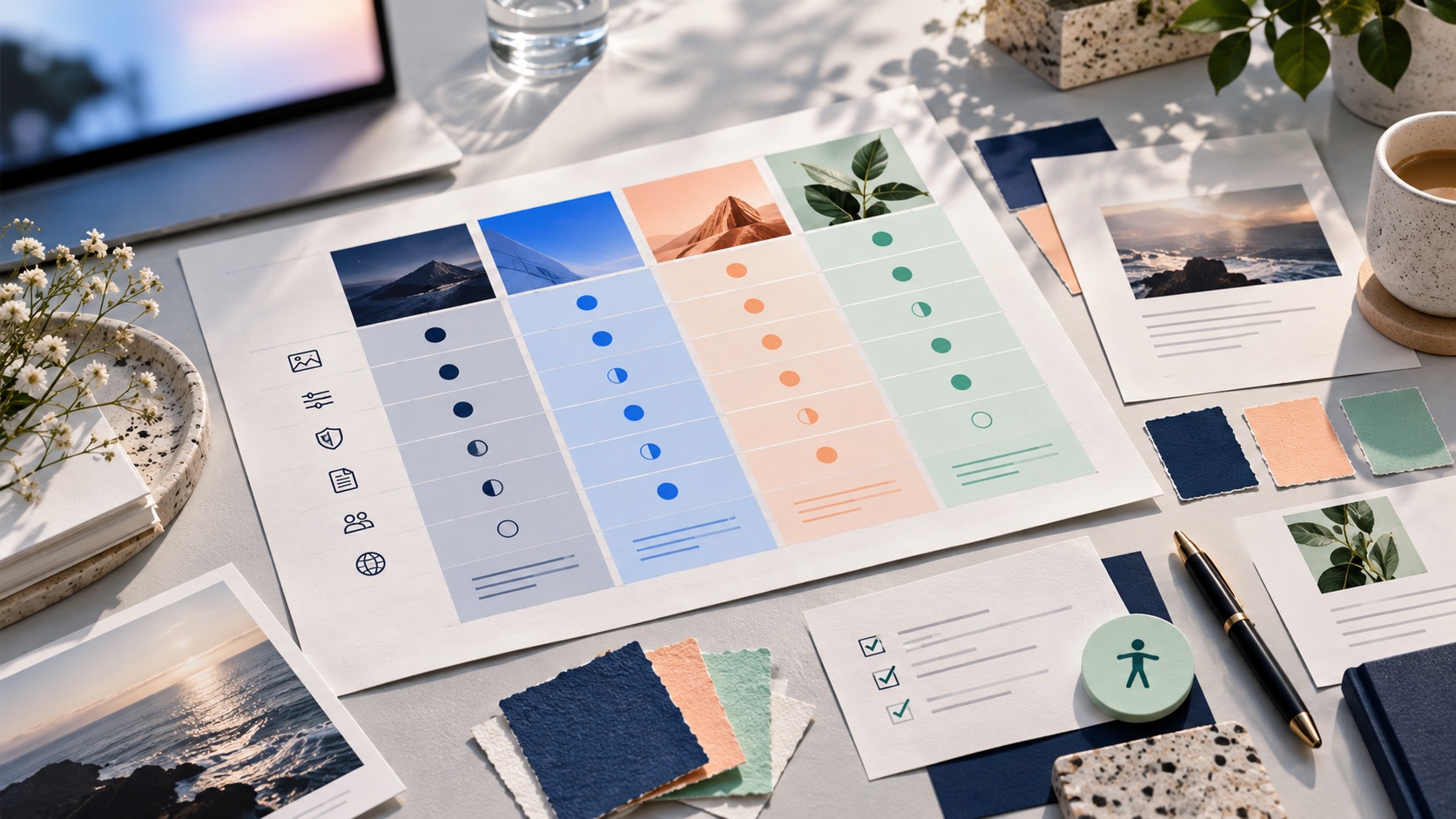
Shortlist tools using your real briefs, then score output control, rights information, workflow fit, and accessibility. Do not treat a vendor’s gallery as evidence that it will solve your production problem.
Define the job before comparing products
“Best image generator” is not a useful category. A social editor making lightweight concepts, a designer creating campaign assets, and a small team producing customer-facing diagrams are choosing different systems. Write the deliverable, publishing channel, turnaround time, source-material constraints, and consequence of a wrong image. Then decide whether you need ideation, controlled editing, consistent series work, illustration, photorealism, or transparent-background assets. This prevents the evaluation from collapsing into aesthetic preference. A tool can be delightful for exploration and unsuitable for a regulated client workflow; both facts can be true.
0Score the controls that affect revision work
A polished first generation is only the beginning. Ask whether you can preserve composition while changing one object, work from reference material within the tool’s rules, extend a layout, maintain an asset ratio, export a useful resolution, and document how an image was made. Test the controls with one realistic revision: change an object without changing the visual hierarchy; adapt the composition to a vertical crop; create a second image in the same art direction. The time lost on unpredictable revision is usually more important than the seconds saved on a first prompt.
- Compare editability, not just initial quality.
- Test the crops you actually deliver.
- Record where human retouching remains necessary.
Treat rights and training claims as a current-document question
Rights, commercial terms, indemnity, data handling, and content-credential behavior can differ by product, plan, geography, and date. Read the official terms and documentation that apply to the account you would buy. Do not turn a marketing phrase such as “commercially safe” into a blanket guarantee. Your team may still need client approval, trademark review, model-release care, or a policy for depicting real people. Save the page URL and check date in your evaluation. A buyer’s guide should identify who owns this verification, not pretend that a generic online comparison can settle it.
0Run a small production-style trial
Give each finalist the same three tasks: an initial concept from a real brief, one constrained revision, and one delivery-format adaptation. Use a scorecard with criteria that matter to the people doing the work: brief adherence, control, usable resolution, revision time, rights clarity, accessibility readiness, and total handoff friction. Include a “cannot verify” option rather than forcing a score. The trial should be small enough to finish in a day and specific enough to expose workflow differences. Keep the prompts and selected outputs so another teammate can review the result.
0Decide what must stay human-controlled
No generator should be asked to carry the full visual judgment. Set approval points for claims, brand fit, representation, unwanted resemblance, legibility, alt text, and final publishing context. A designer may use a model for options while retaining control over the composition and final file. That division is not a limitation; it is the system that makes the work repeatable. If content credentials or provenance metadata are available, understand what they record and what they do not prove. They can support transparency, but they do not replace editorial review or a clear disclosure policy.
0Choose a rollout that can be reversed
Start with one content type and a small group of reviewers. Define a budget, approved account type, storage location, and a stop condition before scaling. At the end of the pilot, compare the real artifacts and revision hours, not a memory of how impressive the first images felt. Keep the final decision memo short: chosen use case, chosen tool or tools, exclusions, owner, policy links, and the date to recheck terms. That gives a small team an operating decision instead of a permanent contest between demos.
0A practical evaluation sheet for a small content team
A useful trial begins with a real, modest brief rather than a speculative art challenge. Suppose a three-person content team needs a hero visual, two social crops, and a simple supporting illustration for a guide. They define the shared art direction, the delivery sizes, the kinds of reference material they are permitted to use, and the review criteria. Each finalist receives the same brief. The team makes one initial concept, then requests a revision that changes a single object while retaining composition, then adapts the approved result to a vertical format. These three tasks expose different realities: prompt adherence, edit control, and handoff friction. The team notes the time spent not only generating but also explaining, selecting, repairing, exporting, and preparing meaningful alternative text. The scorecard uses observations rather than impressions. “Could a reviewer preserve the subject while changing the background?” is observable. “Did the export hold up at the intended size?” is observable. “Where did the official documentation explain commercial terms, account controls, content credentials, or data handling for this plan?” is observable. A category may be marked unclear; forcing every question into a high or low score disguises a research gap. The designated owner reads the current vendor documents and saves the links. If the organization has requirements beyond the available terms, the right outcome may be to restrict the use case or retain a different workflow. The comparison should also include the work that happens after an image exists. Does the design tool make it straightforward to create a series while preserving visual rules? Can a designer do a targeted edit without regenerating unrelated details? Does the team have a clear way to record which asset was selected and why? Are authors tempted to use a generated image where a real photograph, chart, or screen capture would tell the truth better? An image generator is not a substitute for a decision about evidence. For a product review, a stylized illustration should never imply that it is a real interface. For a case study, a generated person should never masquerade as a customer. These are editorial decisions, not merely tool settings. At the end of the trial, the team chooses a narrow approved use: for example, original editorial illustration with human review and a defined archive location. It may explicitly exclude depictions of real people, client brands, regulated topics, or final product representations. The memo names the selected tool, the source documents checked, the reviewer, the expiry date for the decision, and the questions still open. That limited result is more valuable than declaring a universal winner. It gives the team a repeatable choice and preserves the option to revise it when products, plans, or policy change.
- Score revision work and publishing constraints separately.
- Capture a small set of production-like samples, not a gallery of one-off experiments.
- Store only selected delivery media in the final project folder; keep experiments clearly separated.
Questions to ask before you renew
The first purchase decision is not permanent. Put a renewal checkpoint on the calendar and collect the evidence that will make it easy to decide later. Did the approved use case generate useful deliverables? Did revision time fall or merely move into cleanup? Did people understand the restrictions? Were official terms, controls, or account options changed in ways that affect the original assessment? A concise renewal review keeps a temporary experiment from becoming invisible infrastructure. Keep the tool choice separate from the visual system. Your team’s art direction, review process, naming convention, accessibility responsibilities, and source records should work even if the generator changes. That is the practical hedge against fast-moving products: you are building a method for producing honest visual work, not a dependency on one prompt syntax. When a new tool appears, it enters the same small evaluation rather than resetting every past decision. If the evaluation surfaces a hard uncertainty around rights, data, or a client requirement, stop there and assign the question to the appropriate owner. A content team should not improvise a legal conclusion because an image looks usable. The most mature scorecard has room for “not approved for this use” and treats that result as a successful decision, not a failed trial.
0Tool decision checklist
For each finalist, record the exact plan, current documentation links, approved account type, trial brief, initial output, constrained revision, delivery crop, reviewer notes, and unresolved questions. Verify what you can from the vendor’s official material and assign specialist review where you cannot. Do not use a free trial result to assume a paid plan behaves identically. Do not use an impressive sample to assume rights or administrative controls. The decision is ready when the team can explain the approved use, the excluded use, and the date it will review the choice again.
0A decision is stronger when it has exclusions
Write the exclusions directly into the media policy: no simulated product screens presented as fact, no client or personal likenesses without a defined review route, no output published before a human checks meaning and accessibility, and no claim that a general tool comparison guarantees suitability. These limits protect both the audience and the team using the tool. They also make creative experimentation safer because contributors know where it belongs. When evaluating quality, compare the result to the task rather than to a generic ideal. A rough concept may be excellent for an internal storyboard and unusable for an editorial hero. A highly polished image may be unsuitable if its origin, rights assumptions, or revision path cannot meet the job. This is why the same scorecard should be completed by the people who will write, design, review, and publish the work. Their observations turn a demonstration into a grounded tool decision. Keep the final selected image, its brief, its alt text, and its approval note together. That small record gives a future editor a way to understand the visual decision without treating the image model as an authoritative source. It is the same discipline used for any commissioned asset: clear intent, traceable review, and honest presentation.
0Reading a scorecard without false precision
Numbers help a team compare observations, but they should not hide a veto condition. A tool might receive strong scores for concept quality and still be unsuitable because the relevant plan does not document a required control, because a client’s policy excludes the workflow, or because edits are too unpredictable for the delivery schedule. Put these conditions above the numeric total. A weighted score is a conversation aid, not a substitute for the person accountable for the decision. Invite dissent from the people who will inherit the work. A designer may see revision friction that an evaluator misses. An editor may identify an accessibility concern. A privacy or security owner may need a different document before any pilot can expand. Record these comments next to the trial samples rather than resolving them with a vague “we will monitor it.” Specific unresolved questions have owners, sources, and deadlines. The same discipline makes a later change easier. If a vendor updates a term or a new tool enters the market, rerun only the tests and document checks affected by the change. You do not need to rewrite the visual system or pretend that every past asset is invalid. You need an honest current decision for the job in front of you.
0Sources and update note
Follow the linked official source before a product, price, plan, or policy decision.