AI Workflows · Guide
Turn Field Notes Into a Research Debrief With AI
Organize observations faster while keeping participant context and the researcher's judgment visible.
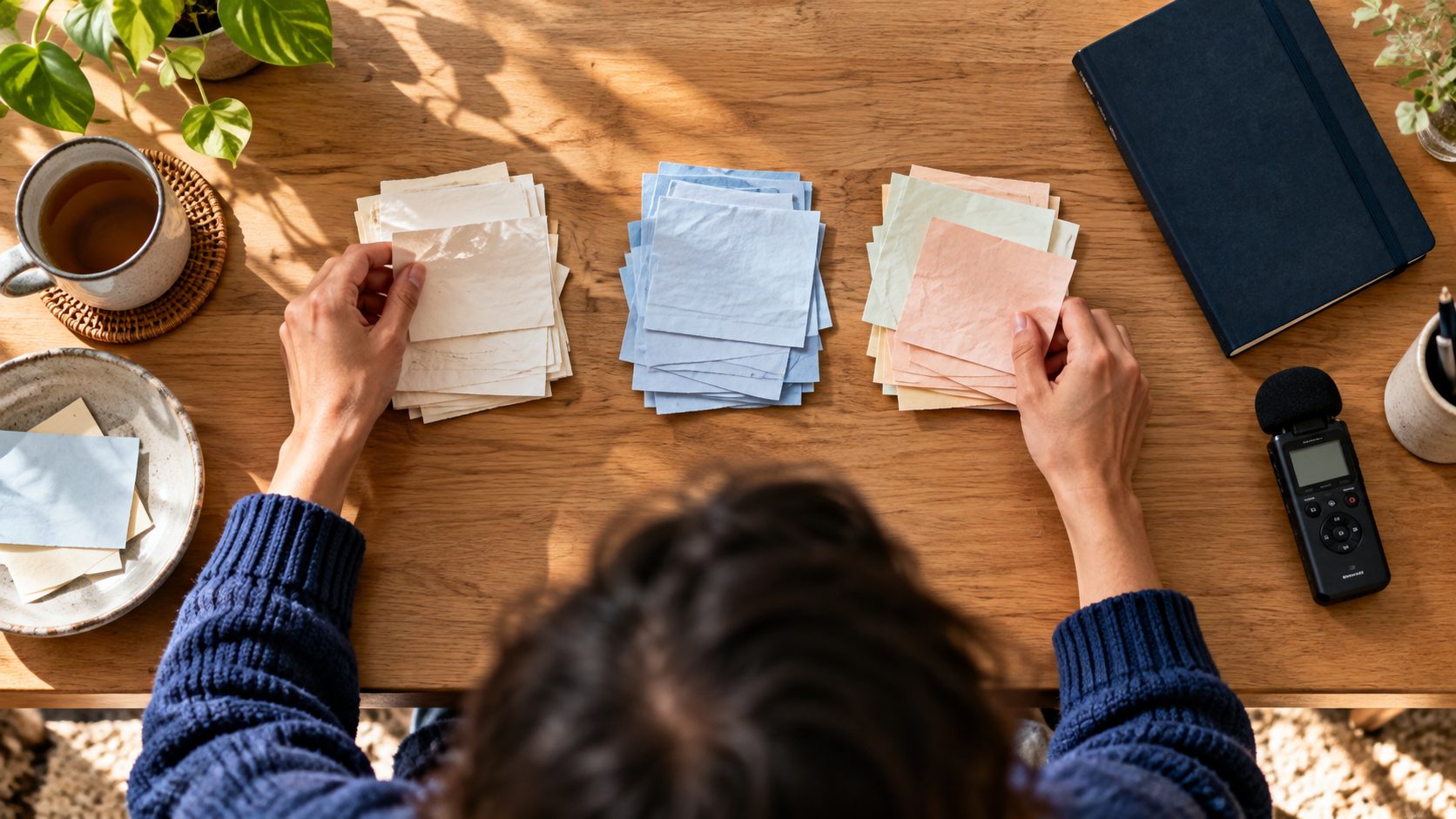
A researcher returns from several observations with fragments: a remark about a confusing button, a pause before a decision, a workaround used twice, and a question that the study did not answer. AI can help organize those fragments, but a neat summary is not the same as a finding. The debrief should show what people actually did, how the team interpreted it, and what evidence would change that interpretation. Begin with material you have permission to process. Remove names and details that are unnecessary for the research question. Keep the original notes in the approved research location, with session identifiers and consent boundaries. The assistant needs a bounded set of de-identified observations, not unrestricted access to recordings or participant histories. If consent does not cover the proposed tool, organize the notes without it.
Make a traceable note set
Give each observation a short ID and preserve its session context. For example, “P03, checkout task, paused before shipping choice” is more useful than “users were confused.” Record the task, what was visible, the participant's action or words, and the researcher's interpretation in separate fields. A participant who pauses may be confused, comparing prices, or waiting for a page to load. Do not put the interpretation into the observation field and then ask AI to validate it. Ask the assistant to group observations by the study questions, while retaining the note IDs. It can suggest candidate themes and identify contradictory notes. It should not invent participant quotes or collapse three people into “most users.” A good debrief lets another researcher trace a theme back to the actual sessions without exposing more personal information than necessary.
Review themes against counterexamples
For each suggested theme, ask which notes support it and which notes weaken it. A model may cluster all “hesitation” notes even when the pauses occurred at different steps for different reasons. Read the original notes and, when permitted, revisit the recording at the relevant time. Separate recurring behavior from one striking anecdote. If a theme depends on an uncertain observation, label it as a question for the next study rather than a settled insight. Use plain counts only when the sample and measurement support them. “Three of six participants looked for shipping costs before entering an address” can be useful if that is what the notes show. It should not become “half of customers need a new shipping page.” The debrief describes this study, not the whole audience. Note recruitment and task conditions so a stakeholder can judge how far the finding travels.
Connect findings to a decision
A debrief should help a team decide what to investigate or change. For each high-confidence observation, write the current experience, evidence, possible explanation, and next test. A team might move shipping cost information earlier, but it should also ask whether the observed hesitation came from unclear delivery timing. Present the recommendation as a hypothesis when the evidence does not distinguish these causes. AI can propose possible explanations; the research team chooses what the data actually supports. Make the output short enough to use: a one-paragraph study context, three to five findings, important counterexamples, limitations, and next actions with owners. Link to the approved evidence repository for colleagues who need detail. Do not paste entire transcripts into a slide deck. The debrief is a route to evidence, not a replacement for it.
One small example
Suppose two participants fail to notice a “save draft” action and one participant notices it but expects an autosave. A generic AI summary might say “users cannot find save.” A stronger debrief separates the observations: discoverability failed for two people, while the third had a different expectation about persistence. The team can test a clearer action label and a status message, but should also verify what happens after navigation. Those are different design questions. Keeping note IDs attached prevents the neat theme from erasing that difference. Finish with a human read-through. Ask another researcher to inspect one theme and its source notes. If they cannot reconstruct how the conclusion arose, revise the debrief. The aim is to make the team faster at seeing patterns without giving up the discipline that makes a pattern credible.
Try this next
label ten de-identified observation notes with stable IDs and ask AI for two candidate themes plus the strongest counterexample to each.
Sources and update note
Follow the linked official source before a product, price, plan, or policy decision.