AI Tool Decisions · Guide
Evaluate AI Transcription With a Real Test Set
A short, representative recording set reveals more than a polished product demo.
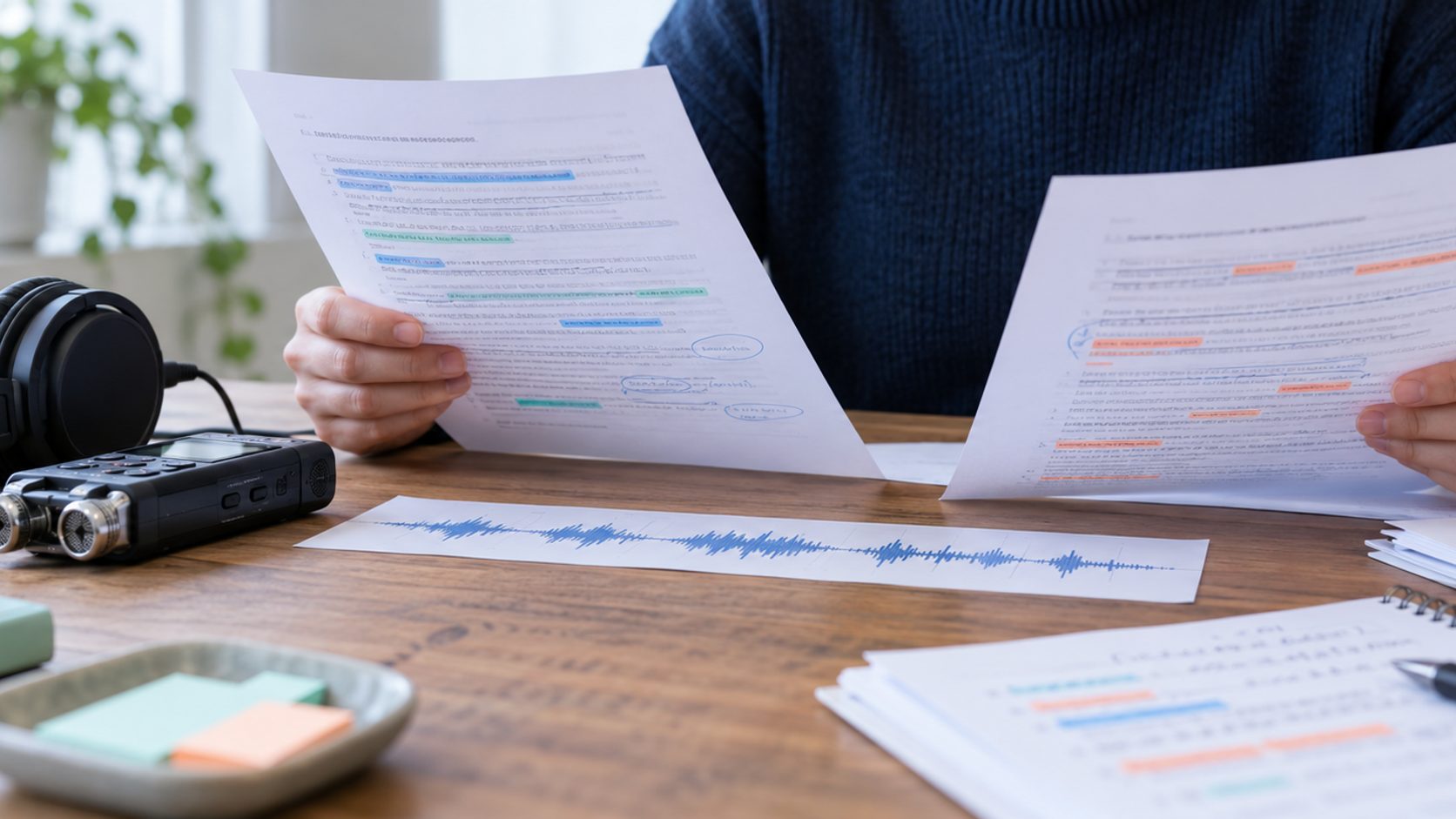
Automatic transcription is often described with a single accuracy number. That number rarely tells a team whether the tool will help with its own recordings. An interview with two clear speakers in a quiet room differs from a workshop with overlapping voices, specialist vocabulary, and a poor microphone. The practical question is not “Which tool transcribes best?” It is “Which workflow gives us a trustworthy transcript at an acceptable review cost?” A small test set can answer that question without turning the selection into a major procurement project. Use recordings you are allowed to process, remove unnecessary sensitive material, and include the conditions your team encounters most often. If you cannot put a recording into a vendor's system under your current privacy rules, that is a selection result, not a test to work around.
Choose five representative clips
Select short clips that cover normal and difficult cases: a clear one-to-one interview, several speakers, a remote call with uneven audio, specialist terms or names, and one clip with interruptions or background noise. Keep each clip long enough to include complete ideas rather than isolated words. Prepare a manually checked reference transcript for a portion of each clip. Write down what matters to the downstream job. A podcast editor may prioritize timestamps and speaker turns. A research team may care most about names, quotations, and searchability. A customer team may need an export that fits an approved record system. This list becomes the review rubric.
Illustrative prompt · adapt before use
From the supplied test rubric and reference transcript, classify errors by consequence. Report names, numbers, negations, speaker turns, timestamps, editing minutes, and uncertain spans separately.Score errors by consequence
Count obvious word errors, but also classify them. A missed filler word is often easy to correct. A wrong number, negation, speaker label, or product name can change meaning. Mark how long an editor spends finding and fixing each kind of error. A transcript that looks clean but hides a few consequential mistakes may take more careful review than a rougher one whose uncertainty is easy to spot. Do not assume diarization or timestamps are correct because they appear precise. Check speaker changes during interruptions and inspect a few timestamps against the audio. If the tool offers confidence markers, see whether they correspond to the passages your reviewer finds hard.
Test the editing and export workflow
Open the transcript in the interface a real teammate would use. Can they replay a phrase quickly? Is it easy to correct a name once or across the document? Can they preserve the original audio and export a version with timestamps and speaker labels? Try the export before deciding. A polished editor is less useful if its output drops information the next step needs. Record setup time, review time, and cleanup time for each clip. Include the work of moving files into and out of the system. A tool should reduce total effort for the job, not merely produce text faster than a human can type.
Review permissions and retention
Before testing real material, check who may access the recording, where it is sent, how long it is retained, and whether it may be used to improve a service. Use the provider's current terms and your own organization's requirements; do not infer privacy from a marketing label. Keep a separate path for recordings that are too sensitive for the tested service. The result of the pilot can be a simple decision: use the tool for routine interviews, use it only for low-risk drafts, or keep a human transcription path for this material. Document the test clips and criteria so a later product update can be evaluated with the same evidence.
Make the comparison fair and repeatable
Run each candidate on the same files and record any preparation steps. One product may improve when you supply a vocabulary list; another may require manual speaker setup. Those features are valid parts of a workflow, but note the extra time and expertise they require. Compare defaults first, then compare supported adjustments in a second pass. Do not clean the difficult audio for one product and leave it raw for another. Keep the original clips and reference transcript in an approved location so a later product update can be checked against the same task. Give reviewers a small scoring sheet with separate fields for names, numbers, negations, speaker turns, timestamps, unintelligible spans, and export quality. A single aggregate error rate may hide the failure that matters to your use. If the transcript will support a published quote, a wrong negation is a veto until the audio is checked. If it will only help an editor navigate a recording, imperfect punctuation may be acceptable. Decide these rules before seeing the product names or marketing claims. A reviewer should be able to explain why a tool passed a particular job, not merely report that it “felt accurate.”
Include an example that changes the decision
Imagine two candidates on a specialist interview. Candidate A produces smooth sentences but silently changes a product term and assigns a contested statement to the wrong speaker. Candidate B leaves that segment rough and marks the uncertainty near the relevant timestamp. A word count could favor A while an editor preparing quotes may prefer B because the risk is easier to find. Record the exact passage, correction time, and consequence. The example shows why transparency and editing affordances belong in the evaluation alongside transcription quality. Test a follow-on task, such as finding a topic, exporting a review copy, and tracing one quotation to audio. If a tool loses timecodes on export or requires an inaccessible format, the downstream editor may have to reconstruct the evidence. Include accessibility for the people doing the review: keyboard navigation, readable playback controls, and a way to distinguish speakers without relying only on color. The winning tool is the one whose whole path fits the team's work and data rules. If neither does, keep the human route rather than presenting a forced ranking.
Decide when to retest
The test set is a reusable decision aid, not a permanent verdict about a product. Recheck after the team changes recording conditions, uses a new language, adds new specialist terms, or considers a substantial tool update. Preserve the same baseline clips and add a few new examples from the changed work. Document the account type and setting used because a feature demonstrated in one plan may not exist in another. Revisit the privacy review if data handling or the organization’s own policy changes. This makes the comparison honest without turning it into continuous benchmarking.
Set a use-specific acceptance threshold
The test should end with a decision rule tied to the intended use. A transcript for rough navigation may pass when an editor can quickly locate relevant audio, even if punctuation is imperfect. A transcript supporting quotation needs a higher bar: every used quote, speaker, number, and negation checked directly against the recording. A transcript entering a customer record may require approved retention and access controls before accuracy is considered. Write these conditions next to the scores. A high average should not compensate for a failed privacy boundary or an untraceable quotation. If the team cannot agree on a threshold, run a short review session with the people who will use the transcript. Ask them to correct a representative clip and describe what would make the output unsafe or too expensive to use. Their feedback can identify an operational problem the test rubric missed. Record the final choice as “suitable for this use under these conditions,” not “best transcription tool.” That phrasing remains honest when the next recording or product version changes. Try this next: pick one clear clip and one difficult clip, create a checked reference for two minutes of each, and measure both consequential errors and human correction time.
Sources and update note
Follow the linked official source before a product, price, plan, or policy decision.