AI for Creators · Guide
Turn an Expert Interview Into an Accurate Explainer With AI
Use AI to organize the conversation while preserving the expert's meaning, limits, and attribution.
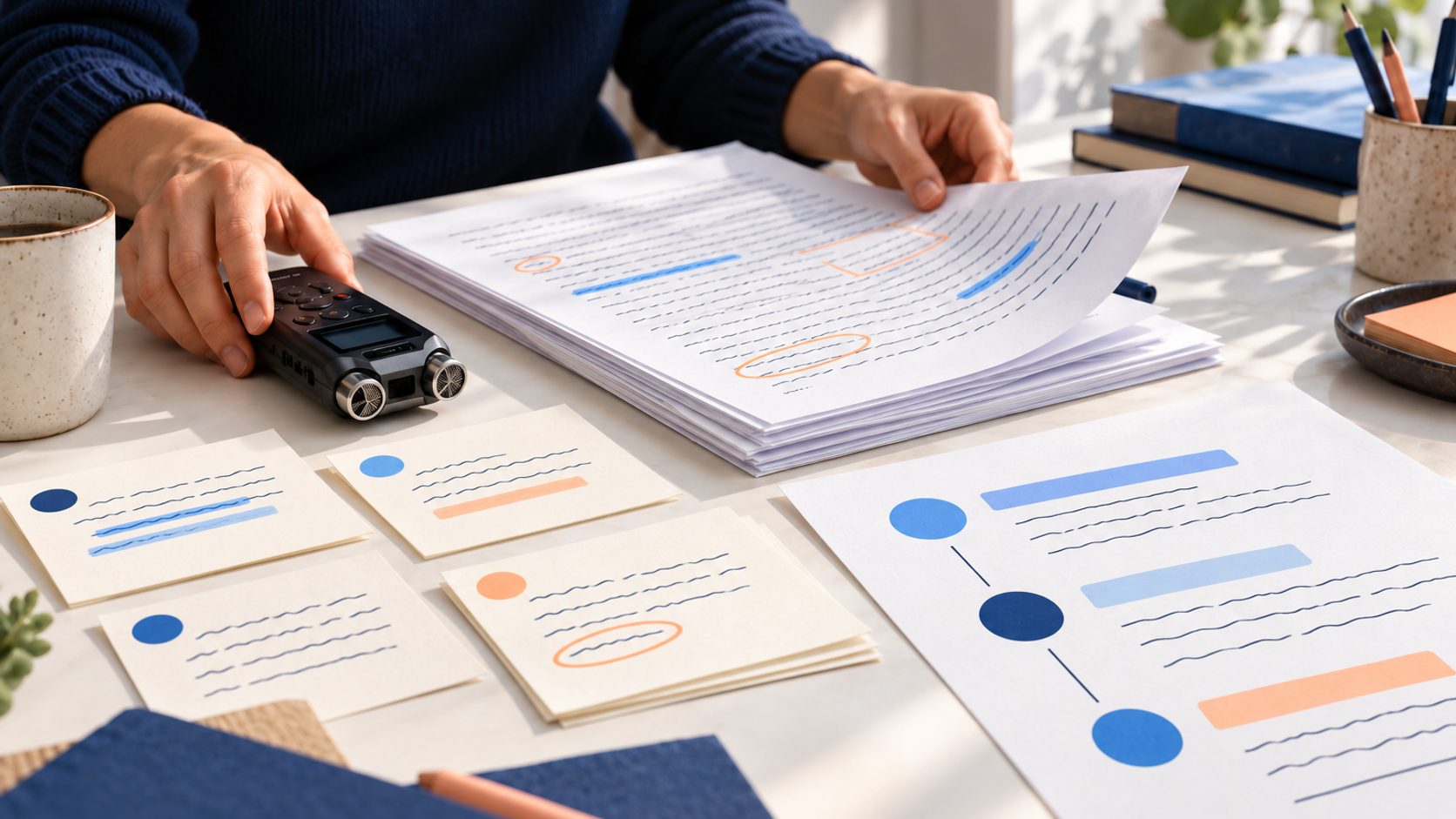
An expert interview can make a technical subject understandable. It can also be easy to misuse. A transcript is full of shorthand, unfinished thoughts, and answers that depend on the question immediately before them. AI can quickly group the material into themes, but it cannot decide which simplifications the expert would stand behind. The editor's job is to turn the conversation into a useful explanation without making the source sound more certain than they were. Start with a real reader question. “What should a small team check before adopting this workflow?” is a better assignment than “write an article about the interview.” The question tells you which parts of the conversation belong in the piece and which interesting detours should remain in the notes.
Build the source pack
Keep the original recording or notes, a checked transcript, the interview questions, and any documents the expert cited. Mark places where the transcript is uncertain. Proper names, numbers, negations, and technical terms deserve direct review against the recording. A single missed “not” can reverse the advice. Create a simple claim table: what the expert said, the time or page where it appears, whether it is a quotation or a paraphrase, and what independent source is needed. AI may help propose this table, but an editor should verify each entry. A confident summary without a source location is a lead to investigate, not a publishable fact.
Illustrative prompt · adapt before use
Using only the checked interview excerpts and claim table, outline an explainer for the stated reader question. Cite the source passage for each claim and mark gaps; invent no quotation or universal rule.Organize by reader need rather than interview order
Readers rarely need the conversation in chronological order. They need the central answer, the conditions under which it applies, and an example they can recognize. Ask AI for a few possible outlines using only the source pack, then choose the one that answers the assignment most directly. An outline might move from the problem, to the expert's method, to a concrete case, to the limits and next steps. Do not let the outline turn every remark into a universal rule. If the expert described what worked for one team, write it as an example from that team. If the expert was unsure, preserve that uncertainty. A clear article can still say, “The interview did not establish whether this applies to larger organizations.”
Handle quotations and paraphrases differently
Use a direct quotation only when the exact wording matters. Check it against the recording and keep enough context that the meaning is intact. For most of the explanation, a careful paraphrase is easier to read. A paraphrase still needs attribution when the idea belongs to the interviewee. It should not combine two separate answers into one invented statement. AI drafts are especially prone to smoothing rough speech into polished certainty. Compare each attributed sentence with the source. Ask: did the expert actually make this claim, was it conditional, and did another speaker challenge it? When the answer is unclear, ask a follow-up question or leave the claim out.
Verify the finished page
Fact-check the article's own statements beyond the interview. A source can share expertise and still misremember a date or describe a product that has changed. Review headings, pull quotes, captions, links, and the summary box as carefully as the body; those elements often compress nuance even further. If the piece offers a procedure, ask a reader who did not attend the interview to explain what they would do first and where they might need more information. The final explainer should make the expert's contribution visible and the reader's action clear. Keep the source pack and claim table with the editorial record. That small trace makes corrections possible without re-reading an entire interview when a question arises later.
Build an evidence map before a narrative arc
An explainer needs a coherent sequence, but narrative flow should not decide what the evidence says. Make a small map with four columns: reader question, interview passage, independent support if needed, and limit or uncertainty. A reader might ask, “When is this technique appropriate?” The expert may answer only for teams with a particular skill or dataset. The map should keep that condition attached to the recommendation. If a passage lacks context, return to the recording or ask a follow-up rather than inferring an answer from an adjacent paragraph. Ask AI to propose headings from verified rows of the map, not from the whole unreviewed transcript. This limits the chance that a lively aside becomes the article's central claim. Put each proposed paragraph back against its supporting row. If the outline requires a transition the interview did not establish, write it as the publication's own explanation and support it independently. Do not attribute an editor's synthesis to the expert simply because the two ideas appear near each other. A good structure helps the reader find the answer while preserving the source's actual boundaries.
Check a worked example end to end
Suppose an expert says a small research team improved document retrieval after labeling ten representative questions. A draft might compress this into “Ten questions are enough to evaluate any retrieval system.” That statement exceeds the interview. The example was one team’s small trial, not a universal sample-size rule. The explainer can instead describe what the team did, why those questions were chosen, what the test exposed, and which decisions remain specific to that context. Add a sentence saying that another team should choose examples from its own work and review the result against its own consequences. Give the expert a focused verification request: “Does this paragraph accurately describe your example and its limit?” Avoid asking them to approve an entire polished article without showing the passages attributed to them. A factual correction from the expert should be incorporated, but the editor still checks claims against documents and other sources. If the expert changes a claim after the interview, note which statement is current and whether the article needs a visible correction. This keeps source review meaningful without transferring editorial responsibility to the interviewee.
Write a usable prompt with an explicit stop rule
A bounded prompt can say: “Using only the checked transcript excerpts and source table below, propose an outline that answers the reader's question. For each section, list its supporting passage and any open verification question. Do not invent a quotation, convert a conditional statement into a rule, or supply facts from memory. If the evidence cannot answer the question, mark the gap.” The output is an editorial worksheet. It is not a permission slip to publish. The reviewer should be able to reject an unsupported outline before spending time polishing it. After drafting, use a reverse check. Extract every attributed claim from the article and find its source location. Then read the source passage with the question that elicited it. This catches a subtle failure: a true sentence can mislead if it originally answered a narrower question. Check headings and summary lines too; readers often see those without the qualifying paragraph. The final page should be shorter than the source pack because it serves the reader, but every retained assertion must be traceable. Keep the unused material out of the article rather than using it merely to make the story feel fuller.
Preserve attribution in every format
The page may appear as a search excerpt, newsletter summary, social card, or audio script. Those shorter formats can strip the qualification that made the original sentence fair. Before release, inspect the headline, dek, image caption, pull quote, and promotional copy against the claim table. If the expert said a practice helped one team under particular conditions, a headline should not announce that it works for everyone. Name the expert's role accurately, and distinguish a personal observation from a published study or an organizational position. Keep a correction route visible to the editor. If a reader or interviewee challenges a sentence, the source location and draft history should let the team review it without reconstructing the entire conversation. If the article changes a material claim, update the summary and related excerpts as appropriate. The work is complete when the reader receives a clear explanation and the publication can show how it reached that explanation. Fluency alone is not the test. Try this next: use one ten-minute interview segment to build a claim table and a three-section outline. Write the first section only after every quotation and paraphrase has a traceable source location.
Sources and update note
Follow the linked official source before a product, price, plan, or policy decision.