AI for Creators · A guide
Turn One Podcast Episode Into a Week of Useful Content
Repurpose an episode by extracting its real ideas, assigning each one a reader job, and editing every format for its own context.
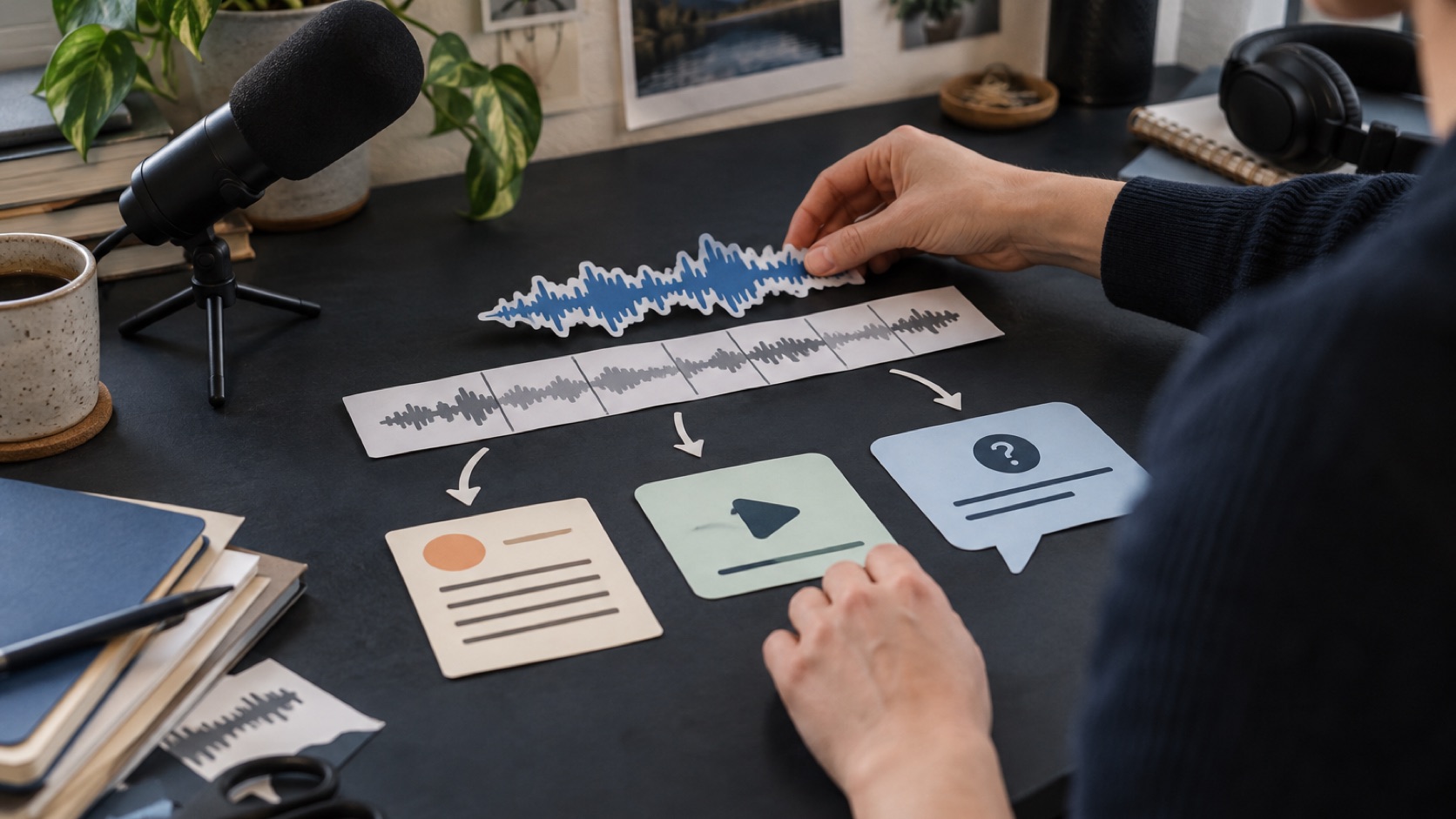
One episode can support a week of content when you begin with a clean source file, extract distinct ideas, choose formats by reader need, and review each derivative for context rather than simply cutting it shorter.
Treat the episode as source material, not as a content vending machine
A long conversation contains detours, jokes, corrections, and ideas that make sense only in the room. Repurposing works when you preserve the useful thought while changing the format for a new reader. Start by naming the episode’s central promise: perhaps a founder explains how she chooses one research question per week, or a designer describes why a visual brief failed. Then identify three to five content atoms: a tension, a method, a surprising example, a useful question, or a warning. An atom is not simply a timestamp. It is a complete idea a reader can understand with a little context. This prevents a common failure: publishing clipped remarks that sound dramatic but become misleading after the surrounding explanation disappears.
0Create a dependable source pack first
Use the best available recording, transcript, speaker names, episode notes, and any cited links. Automated transcription can accelerate the first pass, but review proper names, technical terms, numbers, and moments where a speaker changes direction. Mark the time range for each selected atom and retain enough surrounding context to explain it later. If a guest’s story includes a claim about a company, tool, or result, do not turn it into a general fact without independent support. A source pack keeps attribution close to the material and lets an editor answer a simple question: where did this statement come from, and what did the speaker actually mean?
0Map each atom to a reader job
Do not post the same excerpt everywhere. A newsletter reader may need the argument and a link to the episode. A social reader may need one clear question worth considering. A short video may need a visible quote with captions and enough pacing to understand it sound-off. A companion article may need the method reconstructed with sources and caveats. For example, an episode atom—“we stopped collecting every note and created one weekly decision page”—can become a newsletter paragraph about the method, a social prompt asking readers what they revisit weekly, and an article section explaining the decision-page template. Each version has a different job, so each needs its own opening and close.
0Build a seven-day sequence around usefulness
A modest sequence may be more effective than flooding every channel on release day. Day one: publish the episode with clear notes and an accurate title. Day two: send a newsletter that frames the central problem and one actionable insight. Day three: share a short, contextual social post that asks a related question. Day four: publish a visual quote or clip with captions. Day five: turn one method into a checklist or article section. Day six: answer a listener question or clarify a limitation. Day seven: resurface the episode for readers who need the full discussion. The sequence is not a law. It is a planning device that gives every reuse a reason to exist and leaves room for review.
0Example: turn a planning conversation into three honest pieces
Imagine a guest says she records every project decision in a shared page so collaborators can see what changed. The newsletter can summarize the practice and link to the episode: “A shared decision page is not a replacement for discussion; it is a record of what the group agreed.” A short social post can ask, “Where does your team record decisions that change the work?” A longer article can show a sample structure: decision, evidence, owner, date, and next review. None should claim that the guest’s method works for every team. The value comes from making the specific practice visible, then helping a reader decide whether to test it in their own context.
0Edit clips and quotations for meaning and access
A clip is not ready because its transcript has words. Check that the opening establishes the speaker and topic, captions identify meaningful sound or speaker changes where needed, and the final frame does not cut off a qualification. Avoid editing a thoughtful answer into a slogan that reverses its intent. If you use a quote card, include enough attribution and a link or episode reference for a reader to locate the full conversation. AI can help find candidate timestamps or draft captions, but a human should check names, emphasis, timing, and context. The goal is not maximum extraction; it is a smaller library of pieces that remain fair to the speaker and useful to the reader.
0Review the week and keep a source trail
At the end of the sequence, save the selected atoms, final copy, clip time ranges, approvals, and corrections. Note which format produced a useful response and which one created confusion. Do not infer a universal engagement rule from a single week; use the record to improve the next episode’s brief. If a guest request, correction, or rights question appears, preserve the original material and route it to the responsible editor. A sustainable repurposing workflow is a content memory: it lets you revisit a good conversation without losing the conditions that made it worth sharing.
0Clean the transcript before extracting content atoms
A usable transcript is more than text with timestamps. Listen again at the selected passages and correct speaker names, acronyms, numbers, interruptions, and places where a speaker revises an earlier point. Mark laughter or pauses only when they affect meaning. Add a short context note beside every potential atom: what question prompted it, what came immediately before, and what limitation followed. This small cleanup keeps a clipped sentence from carrying a meaning the full conversation did not support. Create an atom map with four columns: idea, evidence or example, best audience moment, and format risk. A practical method may become a newsletter section and a checklist. A personal story may fit a clearly attributed clip but not a general how-to article. A disputed claim may need a follow-up episode or independent reporting before reuse. For each atom, write the smallest complete unit a reader needs: a one-sentence framing line, the point, and the consequence. This gives an editor material to adapt instead of a pile of attractive fragments.
0Plan channels as a sequence and review what changed
For a seven-day run, assign one purpose per day: release the complete conversation; explain one method in email; ask one contextual question in social; share a captioned clip; publish a checklist; correct or deepen a limitation; and offer the full episode again to readers who need the larger argument. Prepare each asset from the atom map, not by automatically shortening the prior asset. The email can include a link and a useful synthesis. The clip can foreground the speaker and topic. The checklist can tell a reader what to try. At week’s end, compare the planned purpose with the finished assets. Which atom survived adaptation best? Did a clip invite a question that required a clarification? Did captions introduce a name error? Did an audience response show that the opening lacked context? Save corrections beside the atom rather than silently replacing them. This review does not require broad claims about reach or performance. It produces a better source record for the next episode and makes reuse more accurate over time.
0A 42-minute interview becomes four useful assets
Suppose a 42-minute interview features a freelance producer explaining how she prepares client approvals before an AI-assisted edit. Do not begin by asking a model for “ten posts.” First make a listening pass and mark four moments: at 04:20 she describes the approval problem; at 11:45 she explains her one-page brief; at 23:10 she gives a concrete revision example; and at 36:30 she names the limit of the method. Re-listen to those sections, correct names and numbers, and write one sentence of context for each. The 11:45 point, for example, only makes sense after the producer has explained that the client—not the tool—sets the final visual direction. This context note prevents a helpful technique from turning into a generic automation promise. The newsletter asset can use the 11:45 and 23:10 moments as a 350-word lesson: open with the client approval bottleneck, explain the one-page brief in three bullets, then show how the producer used it to compare revisions without claiming that approval became automatic. Link to the full episode and attribute the method to the speaker. The short asset is not a chopped version of that email. Select a 35-to-50-second clip from the 23:10 example, start with a spoken setup or an on-screen framing line, provide accurate captions, name the speaker, and end before the surrounding conversation changes the meaning. The social post can ask one contextual question—“What must a client approve before you generate variations?”—then add one sentence explaining that the answer comes from a producer’s specific workflow, not a universal rule. For the FAQ, turn the 36:30 limitation into a reader question: “Can a creative brief replace client review?” The answer should be direct: no; it can make review more focused by recording the decision, constraints, and selected direction. Include a link to the episode and a note about who the answer reflects. This format works because an FAQ needs a stable question and a complete answer, not a striking quote. Where the interview lacks a needed fact—for example, how the producer handles music rights—leave that topic out or seek a separate source. Repurposing does not authorize a new claim. Use one quality gate before any asset is approved. Check source fidelity: can an editor find the exact timestamp or transcript section behind each statement? Check context: does the asset identify the speaker, situation, and material condition that affect its meaning? Check format fit: does the newsletter teach, the short clip stand on its own, the social post invite a relevant conversation, and the FAQ answer rather than tease? Check reuse integrity: did captions, shortening, or a rewritten headline introduce a stronger promise than the interview made? Finally, give every asset the same interview ID and atom ID, for example EP-17/A3, so a correction to the original can be found across channels. The result is a week of distinct work that shares evidence without pretending each format is an independent piece of reporting.
0Keep one approval record across the reuse set
Use a single approval record after the four assets are assembled. It should name the editor, interview ID, selected timestamps, final copy or clip version, caption reviewer, and the decision for each channel: approved, revise, hold, or remove. A hold is appropriate when the interview supports the topic but the adapted asset cannot include the context that keeps it fair. For example, a useful answer about client approvals may be too conditional for a six-second quote card, while it remains suitable for the newsletter. Re-check the record if the source episode is corrected, the speaker asks for an attribution change, or a new headline changes the claim. This small gate helps a team reuse an interview responsibly without forcing every format to carry the same message.
0Sources and update note
Follow the linked official source before a product, price, plan, or policy decision.